
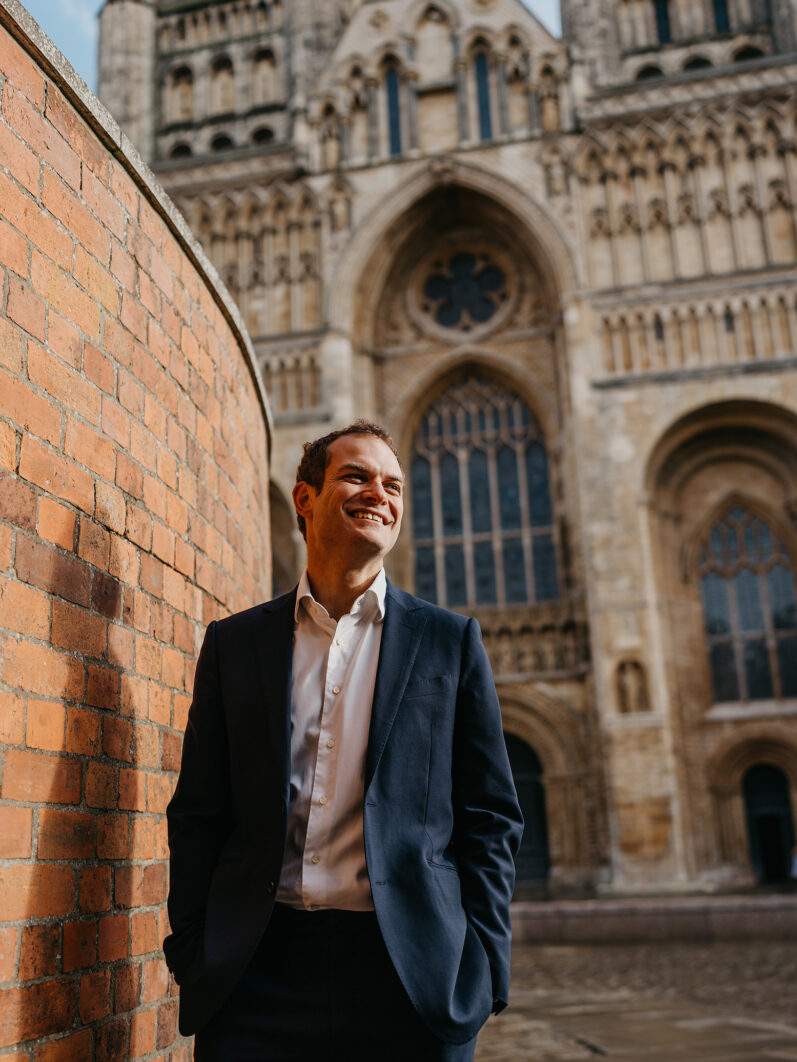
Lincoln is old. In January 1265, when Simon De Montfort’s first parliament met at Westminster, some knight or burgess whose name has been lost to time sat for its people. In the early 14th century when such things were first recorded for posterity, one Hugh Skarlet was named as Lincoln’s MP. In 1529, they sent William Sammes to the Reformation Parliament to wave through Henry’s break with Rome. In the 1860s they sent the radical liberal Charles Seely to argue for manhood suffrage. No other seat has an unbroken line through all the parliaments of England. Only York matched Lincoln, until it was split in two by urban expansion a few years ago. In July 2024, they sent Hamish Falconer. But to do what?
Falconer, 40, is the scion of a political family and product of an elite education at Westminster School and Cambridge University. His early career took him across the world as a diplomat and part-time academic. In a political culture that can sometimes fetishise the local and the authentic, he is conspicuous. He was not born a Lincolnian but has done his best to become one, living in the city for a number of years now since he first sought selection as the Labour candidate when the Tories were in government. As if to prove his enthusiasm, Falconer delights in taking visitors through the minutiae of local history, from the life of Joseph Ruston to the legacy of “Tank Town”. I had been gently warned by a friend before we met not to let him get too into the weeds of urban planning and local infrastructure as it would end up swallowing most of our time together.
Falconer’s other occupation, of course, is serving as a Foreign Office Minister with special responsibility for the Middle East, Pakistan and Afghanistan. In less than two years he has answered more urgent questions than any other minister in the government, has been near constantly abroad and at the centre of some of the major issues of our time, from the recognition of a Palestinian state to the evacuation of British nationals after the outbreak of the Iran war (unlike Foreign Office colleagues, he was lucky to stay clear of the Mandelson fiasco). In government he is quite widely praised and he was notably not moved from his post in the September reshuffle despite a change of foreign secretary.
His working week begins on Sunday, when he will often begin the journey from this medieval city to wherever in the world he needs to be on Monday. It’s all foreign trips and parliamentary business (those urgent questions) until lunchtime on Thursday when the political and aesthetic profile of his week suddenly turns again: towards King’s Cross station and a London North Eastern Railway through the flatlands of eastern England and up again to Lincoln to dip into his other life as a local MP.

Despite the obvious pressures this routine would put on an ordinary man of 40, Falconer says he loves being a constituency MP, that it is an “amazing” job, and pooh-poohs my suggestion that our system loads too much work onto one person. He rejects out of hand any talk of foreign models where ministers give up their seats to do the job, as we walk the streets of his constituency. One day he is attending peace summits, the next he is worrying about the fate of a closed House of Fraser branch here in Lincoln (fate to be decided).
After crash-landing back from the Middle East he feels it is part of his job to sample new restaurants and fast food joints in the city centre. “Have you ever tried Popeyes Louisiana chicken?” he asks, playfully, “Have you ever had a German Doner Kebab?”. He has had to start avoiding a local curry house with particularly delicious and generous portions.
There are other perks. On our walkabout we are stopped by three avuncular men from the local fire brigade. “Hi Hamish!” they call as one. In this particularly old bit of medieval Lincoln, they are doing a regular round of safety checks on the wooden buildings. Falconer knows the men after accompanying them on supervisory visit to the wooden roof of the 954-year-old cathedral, one of the privileges of the job he says (locals worry about a Notre Dame in the East Midlands).
Despite the distractions of his ministerial brief Falconer has developed and maintained a deep affection for the city and tells me he gets antsy when he is away for too long. “I’ve got an absolutely trash habit, which is that because everyone in the constituency office is on a WhatsApp group with me, on flights and trains and if I’m bored in the Chamber and I think I can hide my phone, I’m just constantly chasing things up. If, for whatever reason, say I have to do a Foreign Office trip and I’m away from Lincoln for more than a week, you just feel that you just do start to lose track of things, but mostly I feel like I’m around and present enough. And also the city is quite compact so you don’t go long without being reminded of whatever issues you’re trying to fix.”
Lincoln is a bellwether seat that tends to return an MP from the party of government. Falconer describes the city in its current situation as “a red dot in a sea of turquoise and blue”. All around us is Lincolnshire, and you can see most of it from this hill at the pinnacle of the town, one of few elevations in this flat part of the country. Out there beyond the city, Reform UK is beginning to nest down: in Grantham, birthplace of Margaret Thatcher, in deprived Boston and at the Grimsby docks. This East Midlands county has swiftly become the party’s homeland, far more vast and imposing a seat of power than the salient of Thanet coast occupied by Nigel Farage. Richard Tice sits as the MP for its coastal lands at Boston and Skegness, Andrea Jenkyns was elected as its first mayor in 2025 and the county council is now also under firm turquoise control (they won 43 of 70 seats in last year’s local elections).
With elections in the city approaching on 7 May, when a third of the City of Lincoln’s Labour run district council is up for grabs, Falconer’s red dot is bleeping brightly on Reform’s electoral dashboard. The prize is modest but significant for the party – Lincoln’s city council has sat for 800 years in the Stonebow, a medieval gatehouse attached to the Guildhall whose windows overlook the High Street, and they want that symbolic seat for themselves. Their project is to complete the turquoise jigsaw across the county at the next election, sweeping up red Lincoln from Falconer while putting the last remaining Tory duffers in the county out of their misery. Even South Holland and the Deepings, the resonantly named seat of Sir John Hayes and the safest Tory constituency in the country, is due to fall to Reform at the next election.
As we walk the streets of the city and pass by its Castle – Falconer tells me to check out the copy of Magna Carta stored there – he recounts for me the story of Lincoln Fair, a harrowing local memory from the 13th century when the people of the city, behind their Roman walls, persisted in supporting the French Prince Louis and the rebellious barons who had named him King, and were then brutally subjugated by the English King’s men for their lack of patriotism. Barbarians under the St George’s cross rapping at the gates. Is something playing on his mind?
His nearest Labour neighbour is Jo White, leader of the Red Wall caucus, over in the Nottinghamshire coalfield seat of Bassetlaw, “a very different seat”, he says. In contrast to White and other Red Wall-ers, Falconer is a member of the soft left Tribune group and was in the Labour Movement For Europe until he became a minister.
That kind of politics is welcome here, he thinks, and he remains insouciant about Reform’s chances of turning his red dot turquoise at the next election: “They’re going to try to take me on but they think I’m one of the hardest to beat. That’s not me being arrogant, it’s because of the nature of the city and because of the nature of the county. They will absolutely feast on the remains of the Tories and their safe seats right across the county. And they think if there is a woke, avocado-eating, left wing citadel in the county, it’s here. They believe internally that the hardest seat for them to take would be Lincoln because we had the highest left-wing vote, it’s the place that will have the strongest anti-Reform vote”.
As we make our way round the streets around the Cathedral that sits at the pinnacle of the city, Falconer is summoned with a “yoo-hoo” from a woman on a stick across the street. He dashes over to greet Grace, a retired doctor, whose eyes go exophthalmic as she tells him exasperatedly “Hamish, the Reform lot have been round to mine again!” It was as though she were breaking news of a murder to Miss Marple. Realising I’m a journalist, she praises Falconer’s work as an MP but says she is unhappy with his father – Charlie Falconer, once minister and confidant to Tony Blair, led the Assisted Dying Bill through the House of Lords until it fell last week.
Falconer had two weeks as a normal MP before Keir Starmer handed him a red box. He made just one speech, his maiden speech, from the backbenches before being pulled onto the front bench. His brief is the hottest of hot potatoes and the work has been non-stop. Foreign Office types I spoke to had a positive view of Falconer (“People always say they want MPs with big life experience, well here he is!” says one). He is credited with pushing Labour’s position on recognising a Palestinian state. He has also been at the centre of debates about Britain’s relationship with Israel and arms supplies which are particularly gnarly on the left, though he says this rarely comes up on the doorstep here in Lincoln. It’s mainly something that interests university students.
And did I know, he asks, that the university was largely built on contaminated land? History again. Ok, I think: so has he heard that pet theory of the online anon right, that Reform’s highest vote percentages align closely with the land of the Danelaw, the northern and eastern parts of the country that were under Viking laws before the Norman Conquest. A little silly perhaps, but the real argument really is that Reform’s success is down to some ineffable historical inheritance that people like Falconer (and people like me) can never really understand. “I’ve heard that,” Falconer says, “but my reflection on Lincoln is that actually it’s got a quite distinctive history and culture. People often come to Lincoln and expect that they will be arriving in a place which is very much like the rest of Lincolnshire.”
For a flavour of its distinct identity, and left-wing traditions, he tells me to make a stop off at the Lincoln Labour Club before I get the train back. It turned out to be a grand if slightly shabby double-fronted building which still stands while the city’s Conservative and Liberal clubs have been sold off. Inside, 50 years ago, one of Falconer’s predecessors, Dick Taverne, made Labour history when he was deselected by left-wing party members and ran in a by-election against his old comrades as the “Democratic Labour” candidate, winning the highest independent vote in British history.
Here in Lincoln, Falconer feels close to his party’s legacy, the party of labour. Our walk will go on until he gets a phone call from the local police chief about some urgent business. As we approach the magnificent west front of the Cathedral, he asks if I know that the enduring symbol of this city is the imp. No, why? Because the stone masons of Lincoln Cathedral left tiny, carved imps in the nooks and crevices of the stonework. “These were like their signatures,” he tells me.
“It’s a sign of the wealth that was here in 1080, when they started building it. But it took two hundred years to finish it. That’s generations of Lincoln people working for their whole lives on this building with the knowledge that they would die before it was finished.”
While he admits that, like other ministers, he reads through the “lacerating” criticism of the government in the papers, Falconer says he remains optimistic about his red dot as we count down to next general election.
“I’m under no illusions that, a bit like the Cathedral, three years from now we will have made a real start but that we won’t have built everything. So in 2029 there will be a whole series of things that will be down payments on the future of Lincoln.”
[Further reading: A certain idea of Ed Miliband]
Content from our partners



Related


Join the debate
Subscribe here to comment